Once you’ve decided to build a stock portfolio through low-cost ETFs, the actual decision comes down to two things: which low-cost ETFs to hold, and which broker to hold them through. Trading fees on European markets have fallen to a fraction of what they were a decade ago, so the real cost that compounds against you over 20-30 years is the fund’s own expense ratio (TER) — plus, for non-EU/US investors, how the fund’s domicile affects the tax you pay on dividends. Here’s a concrete comparison, with real numbers, as of September 2026.
Low-cost ETFs for World and S&P 500 exposure: the core building blocks
For most retail investors, a single globally diversified ETF (or a US-heavy S&P 500 fund paired with something else) does most of the work. All the funds below are UCITS-domiciled in Ireland, available to EU investors, and use physical replication (they hold the actual underlying shares, not derivatives).
| ETF | ISIN | TER | Fund size | Distribution | 1-year return | 5-year return |
|---|---|---|---|---|---|---|
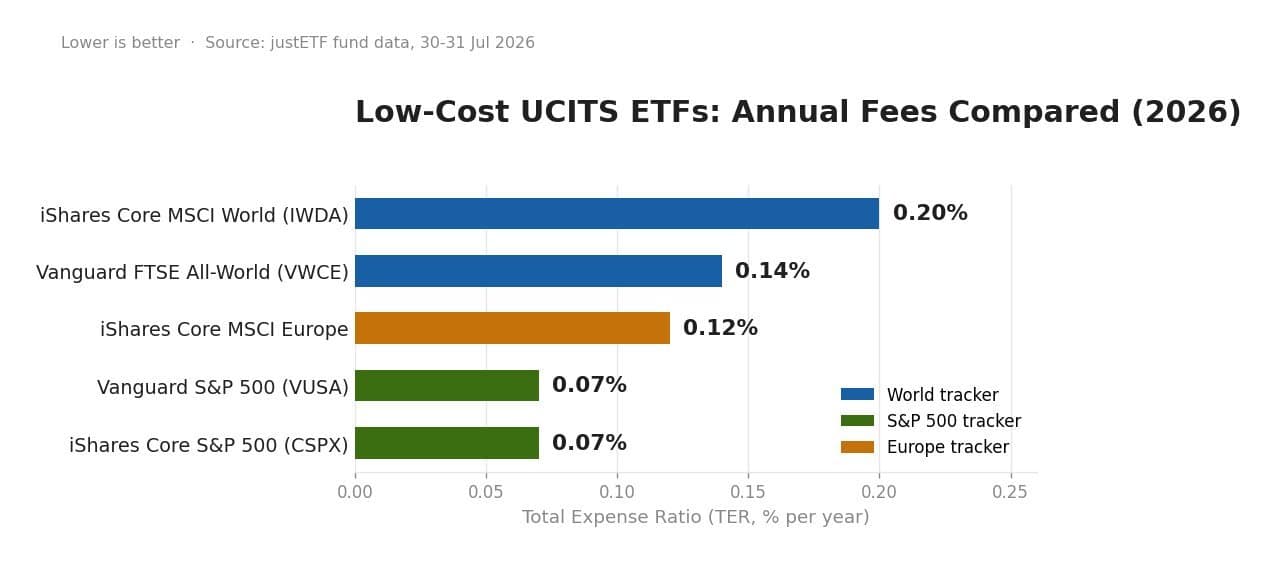
| Vanguard FTSE All-World (VWCE) | IE00BK5BQT80 | 0.14% | €51.1bn | Accumulating | +19.48% | +69.81% |
| iShares Core MSCI World (IWDA) | IE00B4L5Y983 | 0.20% | €128.0bn | Accumulating | +18.08% | +72.71% |
| iShares Core S&P 500 (CSPX) | IE00B5BMR087 | 0.07% | €134.3bn | Accumulating | +17.98% | +83.78% |
| Vanguard S&P 500 (VUSA) | IE00B3XXRP09 | 0.07% | €45.8bn | Distributing (quarterly) | +17.98% | +83.76% |
| iShares Core MSCI Europe | IE00B4K48X80 | 0.12% | €15.8bn | Accumulating | +18.03% | +59.26% |
Source: justETF fund data, 30-31 July 2026. Past performance is not a guide to future returns.
A few things worth noticing. The S&P 500 funds’ 5-year returns (+83.78% / +83.76%) reflect the outsized run of US large-cap stocks over that period — a World tracker like VWCE or IWDA holds roughly 60-65% US exposure already, plus Europe, Japan, and emerging markets on top, so it’s a genuine diversification choice, not just a lower-return version of the S&P 500. And VWCE’s slightly lower TER than IWDA (0.14% vs 0.20%) is a real, permanent 0.06 percentage-point annual difference — small on paper, but it compounds every year you hold the fund.
Note also that VUSA above is the distributing share class of Vanguard’s S&P 500 fund (it pays out dividends quarterly rather than reinvesting them automatically) — the accumulating version trades under the ticker VUAA. If you don’t need the income paid out, the accumulating share class saves you the hassle of manually reinvesting dividends.
Domicile matters more than people think: US withholding tax
If you buy a US-domiciled ETF directly, dividend income is generally subject to a 30% US withholding tax for non-US investors, with treaty relief often limited or unavailable to EU retail investors. Ireland-domiciled UCITS ETFs (like all the funds listed above) benefit from the US-Ireland tax treaty, which reduces that withholding to around 15% at fund level (source: State Street Global Advisors, published 2 June 2026). This is one of the main reasons UCITS funds domiciled in Ireland, rather than US-listed ETFs, are the default choice for EU retail investors — it isn’t just about currency or regulation.
Choosing low-cost ETFs domiciled in Ireland is one of the simplest ways EU investors reduce this drag without any extra effort. This is general information, not personalized tax advice — your own country’s tax treatment of ETF gains and dividends (and any additional local withholding or reporting obligations) still applies on top of this, so check your own situation before investing.
Where you hold them: broker fees compared
The fund’s TER is only part of the cost of holding low-cost ETFs. What you pay your broker to buy, hold, and convert currency matters too, especially if you’re investing smaller, regular amounts:
| Broker | Custody fee | ETF commission | FX conversion fee |
|---|---|---|---|
| Trading 212 | None | Commission-free | 0.15% |
| DEGIRO | None | €0 on “Core Selection” ETFs + €1 handling; €2 + €1 handling otherwise | 0.25% |
| XTB | None (unless inactive 365+ days with no deposit in 90 days) | 0% up to €100,000 monthly turnover, then 0.2% (min £10) | ~0.5% |
| Scalable Capital | None (both tiers) | €0.99/trade (Free); €0 on PRIME/PRIME+ ETF orders ≥€250 | Not disclosed on public pricing page |
| Interactive Brokers | None | Tiered from $0.0005-0.0035/share (US); EU-listed ETF pricing not disclosed on the summary page | Not disclosed on public pricing page |
Source: each broker’s own pricing page, accessed September 2026 (DEGIRO fee schedule updated 1 Oct 2025; XTB Cyprus fee table dated 2 April 2026). Where a broker didn’t disclose a figure on its public pricing page, it’s marked as such rather than estimated — always confirm current fees directly on the broker’s site before investing, since these change.
The FX conversion fee matters more than it looks: if your broker charges 0.5% every time you convert euros to buy a USD-priced holding (or the reverse), that’s a real, recurring cost on top of the fund’s TER — especially if you’re investing monthly. All the ETFs listed above trade in EUR on most European exchanges, which avoids this entirely if your broker lets you buy the EUR-denominated listing.
Where this leaves an investor
For most people starting out, one or two low-cost ETFs — a globally diversified accumulating fund like VWCE or IWDA, held through a broker with no custody fee and a low FX conversion charge — cover the bulk of what a stock portfolio needs to do — broad diversification, low ongoing cost, and no manual dividend reinvestment. Layering in a dedicated S&P 500 or Europe fund only makes sense if you have a specific reason to overweight that region beyond what a World tracker already gives you. If you’re still working out your own objectives, horizon, and risk tolerance before picking funds, our guide to choosing the ETFs that fit you walks through that decision in more depth.
Disclaimer: This article is for informational purposes only and does not constitute investment advice. Investing involves risk, including the possible loss of capital — past performance is not a guarantee of future results. Broker fees and ETF terms change; always confirm current figures directly on the provider’s site before investing. This article does not contain affiliate links.