Benjamin Graham, the investor often credited as the father of value investing, was known for favoring simple, durable ideas over complicated models. One of the most useful is the Rule of 72 — a shortcut that answers a question every investor eventually asks: how long until this actually doubles?
Key takeaways:
- The Rule of 72 is a quick mental-math shortcut: divide 72 by your annual return to estimate how many years it takes to double your money.
- It works because of compound growth, not simple interest — the earlier you start, the more time does the work for you.
- Applied to real examples — savings accounts, diversified ETFs, P2P lending — the difference in “years to double” is dramatic.
- It’s an estimate, not a guarantee. Real returns fluctuate year to year, and higher returns generally come with higher risk.
The formula
It’s just division:
72 ÷ annual return (%) = approximate years to double your investment
No compound interest tables, no spreadsheet — just a number you can calculate in your head.
| Annual Return | Years to Double |
|---|---|
| 3% | 24 years |
| 5% | 14.4 years |
| 7% | ~10.3 years |
| 10% | 7.2 years |
| 15% | 4.8 years |
| 20% | 3.6 years |
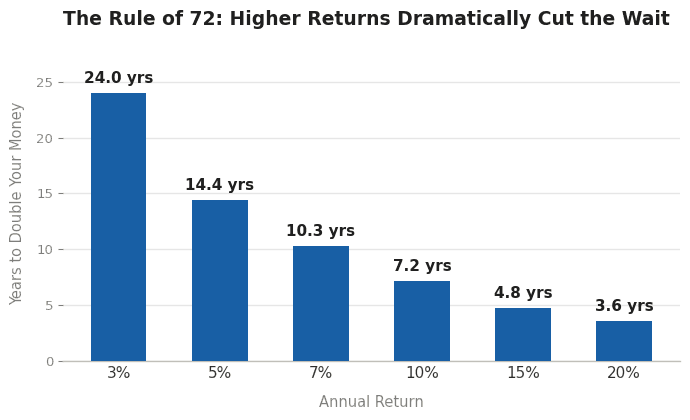
The relationship isn’t linear — doubling your return roughly halves the time, which is exactly why the rate you earn matters so much over the long run.
What this looks like with real numbers
The table above is useful, but abstract. It’s more interesting to map the rule onto the kind of assets we actually cover on this blog — with the caveat that the figures below are illustrative, long-run historical ranges, not guaranteed or current rates. Always check up-to-date figures before making a decision.

None of these is “better” in isolation — they sit at different points on the risk spectrum, and most investors end up blending several. The Rule of 72 just makes the trade-off visible: a diversified ETF portfolio can realistically double roughly every decade, while a savings account might take three decades to do the same. That gap is the price of safety — and it’s worth seeing in black and white before deciding how much of each to hold.
If you’re weighing where actual EUR savings rates stand right now, we compared several options in EUR Savings Accounts Compared: Flexible vs. Fixed-Term Rates in 2026, and if you’re building the ETF side of a portfolio, see Low-Cost ETFs Compared: World, S&P 500, and Europe Trackers in 2026.
The real lesson isn’t the math
The Rule of 72 isn’t really about the formula. It’s about the two things that quietly decide your outcome as an investor:
- How long you stay invested. Compounding needs time to work. Pulling money out early — even to “lock in gains” — resets the clock.
- What rate you’re actually earning, net of fees and taxes. A 2% difference in annual return doesn’t sound like much, but it can mean years of difference in how long it takes your money to double.
As Graham put it in different words throughout his work: the goal isn’t to predict the market, it’s to survive long enough in it for compounding to do the heavy lifting.
A word of caution
The Rule of 72 is an approximation — it gets less accurate at very high or very low rates, and it assumes a steady, compounding annual return, which real markets rarely deliver in a straight line. A diversified ETF might return 15% one year and -8% the next, averaging out to that long-run 7–8% over a decade or more. P2P lending returns depend heavily on platform quality, diversification, and default rates. None of the figures above are promises — they’re a way to think about the trade-off between risk, return, and time, not a forecast.
The bottom line
You don’t need to be a math person to use the Rule of 72 — that’s the entire point. Next time you’re comparing where to put your money, don’t just ask “what’s the return?” Ask “how many years until this doubles?” It reframes the decision around the one resource none of us can buy more of: time.
Disclaimer: This article is for informational and educational purposes only and does not constitute financial advice. Historical and illustrative return figures are approximate and not a guarantee of future results — investing involves risk, including the possible loss of capital. This article does not contain affiliate links.