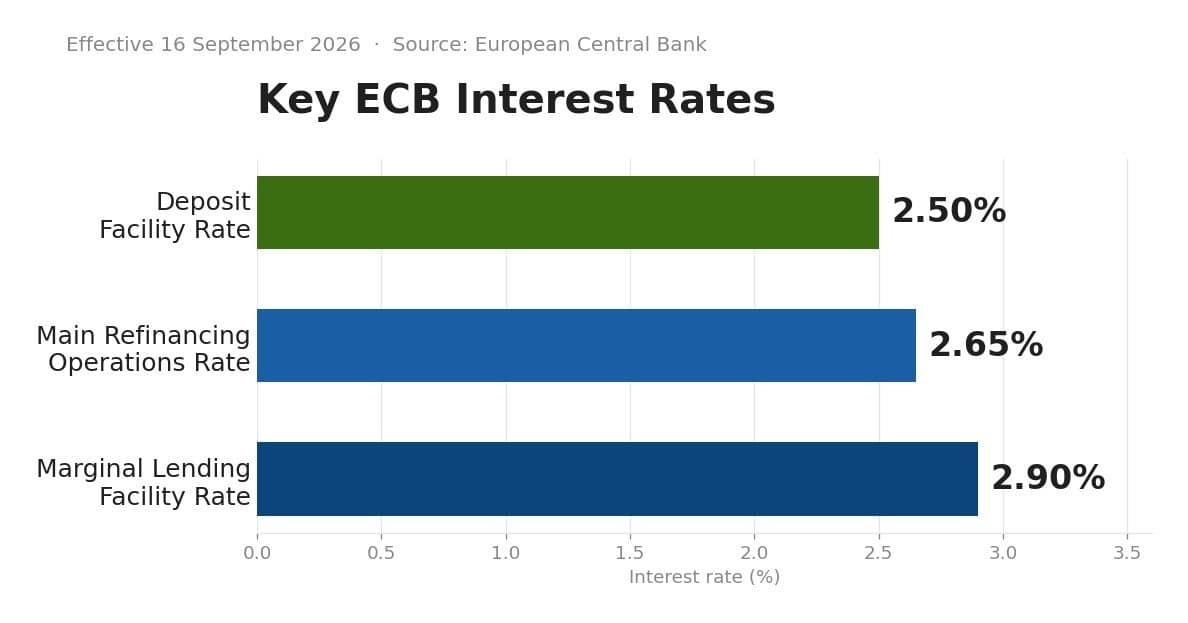
Our ECB rate-hike article covered the policy move itself — the deposit facility rate rising to 2.50% on 16 September 2026 — with a quick snapshot table of savings rates. Two weeks on, it’s worth a closer, dedicated look: which providers have actually passed the hike on to savers, how flexible accounts compare with fixed-term deposits, and what the EUR 100,000 deposit guarantee does and doesn’t cover. All figures below come from each provider’s own rate page or official announcement, checked on 22 September 2026.
Flexible (instant-access) EUR savings accounts
| Provider | Rate | Conditions | Source / date |
|---|---|---|---|
| Scalable Capital | 2.60% p.a. | Overnight account, uncapped balance, monthly payout | Company newsroom, 1 Sept 2026 |
| Trade Republic | 2.50% p.a. | Unlimited cash, free deposit/withdrawal, monthly payout | Official rate page, accessed 22 Sept 2026 |
| bunq | 1.51% base / up to 3.01% above personal threshold | EEA residents, “MassInterest” paid weekly, capped at EUR 100,000 protected | bunq Help Center, effective 1 July 2026 |
| N26 | 0.30% (Standard/Smart) / 0.50% (Go) / 1.50% (Metal) | Flat by membership plan, not linked to the ECB rate | Official savings page, rates effective 6 Nov 2025 |
Two things stand out. First, Scalable Capital and Trade Republic are both sitting almost exactly on the new ECB deposit rate (2.50–2.60%), which is roughly what you’d expect from providers that pass the policy rate through with a thin margin. Second, N26 hasn’t moved: its tiered rates, unrelated to account balance, predate the September hike by almost a year and top out at 1.50% even on the Metal plan — a reminder that “instant savings” products don’t automatically track ECB decisions just because the headline rate went up.
Fixed-term EUR deposits
| Provider | Rate | Term | Source / date |
|---|---|---|---|
| Lidion Bank (Malta) | Up to 3.80% AER | 3 months – 5 years, annual interest payment | Listed via PickTheBank, dated 09/2026 |
| Raisin marketplace | Up to 3.55% AER | Typically 1–3 years, varies by partner bank | Raisin.com, accessed 22 Sept 2026 |
| Raisin Starter Account | 3.10% AER | 3 months, new customers only | Raisin.com, accessed 22 Sept 2026 |
| Scalable Capital | 2.75% p.a. | 12 months, from EUR 1, up to 5 fixed-term accounts held at once | Company newsroom, 1 Sept 2026 |
Locking money away for a year or more still earns a real premium over flexible accounts — roughly 0.2 to 1.3 percentage points more, depending on the provider. The trade-off is liquidity: a fixed term means the money is genuinely unavailable (or penalized) before maturity, so it only makes sense for cash you know you won’t need on short notice. Splitting savings across a few maturities instead of one long term — “laddering” — is a simple way to capture the higher fixed rate on part of your cash while keeping the rest accessible.
What the deposit guarantee actually covers
Every provider in both tables benefits from an EU national deposit guarantee scheme, protecting up to EUR 100,000 per depositor, per bank, if the bank itself fails. A few practical details are easy to miss: the cap applies per banking licence, not per app or brand — so money placed through a marketplace like Raisin is protected by the receiving partner bank’s home-country scheme, not by Raisin itself. Joint accounts are typically protected up to EUR 200,000 combined. And this guarantee is specific to bank deposits — it’s a fundamentally different risk profile from P2P and crowdlending platforms, several of which have collapsed or run into serious trouble while advertising yields not far above what a fixed-term deposit pays today.
Where this leaves a saver in September 2026
For cash you might need at short notice — an emergency fund, money set aside for a near-term expense — a flexible account paying close to the current ECB rate (Scalable Capital or Trade Republic, from the table above) is doing its job properly for the first time in years. For cash you’re confident you won’t touch for 12 months or more, a laddered set of fixed-term deposits captures a meaningfully higher rate without giving up all liquidity at once. And for money with a genuinely long horizon, where you can tolerate volatility in exchange for higher expected returns, a low-cost ETF portfolio still does more for your money than any savings account — cash and fixed-term deposits are for capital you need to protect, not to grow.
Disclaimer: This article is for informational purposes only and does not constitute financial advice. Rates and offers mentioned are indicative as of September 2026 and can change at any time — always verify current terms directly with the provider before opening an account or moving money. Deposit protection covers bank insolvency, not investment risk; investing and holding cash both carry risk, including inflation risk. This article does not contain affiliate links.