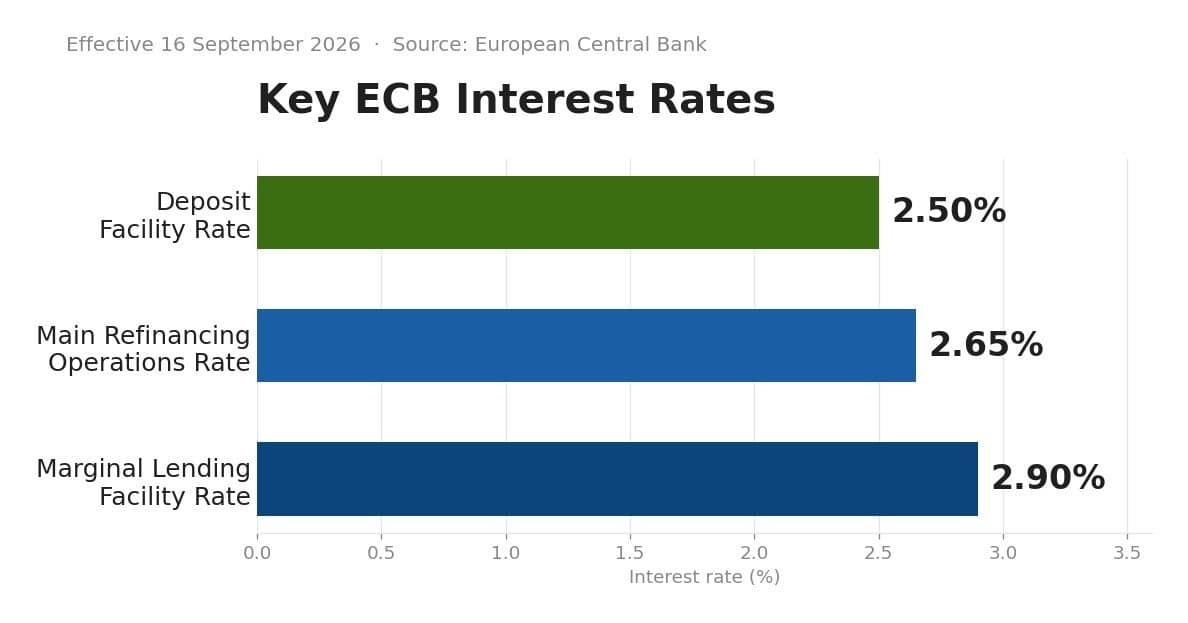
On 10 September 2026, the European Central Bank announced a 25 basis point increase to the ECB deposit rate, effective 16 September 2026: the deposit facility rate rose to 2.50%, the main refinancing rate to 2.65%, and the marginal lending rate to 2.90%. It’s the second ECB deposit rate increase this year, following a similar 25 bps hike in June — the ECB’s first rate increase in three years, driven largely by inflation pressure tied to the conflict involving Iran and its effect on energy prices.
For years, savers in the eurozone got used to near-zero or negative real returns on cash. With the ECB deposit rate now at its highest level in years, that’s changing again, and it’s worth checking whether your own savings and cash allocation are actually keeping up with what’s on offer.
What the higher ECB deposit rate means for savings accounts
Banks and fintechs have started passing the higher policy rate on to depositors. Based on comparisons published in early-to-mid September 2026, flexible (instant-access) euro savings accounts are currently offering roughly:
| Provider | Indicative rate (flexible/instant access) |
| bunq | Up to ~3.0% p.a. (paid weekly, above a personal threshold) |
| Scalable Capital | ~2.60% p.a. (credited monthly, uncapped) |
| Trade Republic | ~2.25–3.0% p.a. (standard vs. new-client rate) |
| Trading 212 | ~2.40% p.a. baseline (higher promotional rates for new clients) |
| Revolut (Instant Savings) | 2.0–2.5% AER, depending on subscription tier |
Fixed-term deposits (1–3 years) booked through marketplaces like Raisin, or directly with banks such as NIBC Direct, Illimity Bank or Pibank, are advertising rates roughly in the 3.0–3.6% range for EUR terms, depending on country and duration.
Rates move fast and vary by country, residency, and promotional terms — treat the figures above as a snapshot from September 2026, not a live quote. Always check the current rate directly with the provider before committing money.
What this means in practice
- Idle cash is now costing you more if it’s parked at 0%. If your bank account still pays little to nothing on your emergency fund or short-term cash, this is a good moment to compare and switch.
- Promotional rates expire. Several of the top offers above are “new client” or time-limited rates. Read the fine print on how long the headline rate actually lasts before it drops to a lower base rate.
- Fixed terms lock in today’s rate — for better or worse. Laddering (splitting savings across several maturities instead of one long term) keeps some liquidity while still capturing higher fixed rates.
- Deposit protection still matters. Bank deposits in the EU are typically covered up to EUR 100,000 per depositor per bank under national deposit guarantee schemes — that’s a very different risk profile from P2P/crowdlending or bond investments, which can offer higher advertised returns but without that guarantee.
Where this could go next
After three years of falling or flat rates, the ECB has now hiked the deposit rate twice in 2026. Whether this marks the start of a longer tightening phase or a short correction will depend largely on how eurozone inflation develops in the coming months. Either way, it’s worth revisiting your savings and fixed-income allocation whenever the ECB deposit rate moves — not just once a year. You can always check the current official rate on the ECB’s key interest rates page rather than relying on a snapshot article like this one once time has passed. If you’re weighing what to do with cash beyond a savings account, see also our comparison of REITs vs real estate crowdfunding returns.
Disclaimer: This article is for informational purposes only and does not constitute investment advice. Rates and offers mentioned are indicative as of September 2026 and can change at any time — always verify current terms directly with the provider. Investing and holding cash both carry risk (including inflation risk); past performance is not a guarantee of future results.