Carnival’s Best Quarter Ever Sends Cruise Stocks Soaring
Carnival Corporation, the world’s largest cruise operator, just posted the strongest quarter in its history — and beat its own forecast on every single metric that matters.
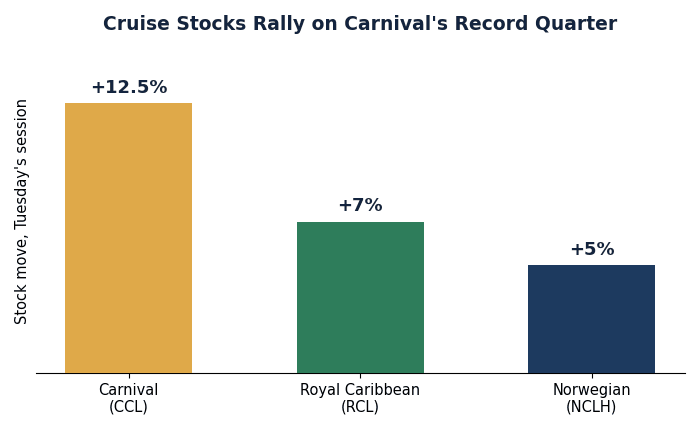
Record revenue, record net yields and record net income all arrived in the same quarter, even as fuel costs jumped sharply. Investors noticed: the stock surged as much as 12–13% during Tuesday’s session, dragging rivals Royal Caribbean (+7%) and Norwegian Cruise Line (+5%) higher with it.
Here’s what actually happened, and why it matters beyond the headline number.
Table of Contents
- Records Across the Board, Despite Pricier Fuel
- Fuel Costs Jumped 36% — But Didn’t Sink the Quarter
- 2027 Is Already Half Booked, at Record Prices
- The Whole Cruise Sector Rallied
- The Main Risk: Oil and Debt
- What This Means for Income Investors
Records Across the Board, Despite Pricier Fuel
The quarter ended August 31, 2026 delivered all-time highs, even though fuel prices and currency effects cut an estimated $131 million from profit.
- Revenue: $8.44 billion, up 3.5% year-over-year and above the $8.30 billion Wall Street expected.
- Adjusted EPS: $1.43, beating both the $1.36 analyst consensus and management’s own $1.35 guidance.
- Net income: $1.92 billion, an all-time record for the company.
- Net yields (net revenue per available berth per day, at constant currency) rose 2.4%, roughly double the 1.2% the company had guided for.
Occupancy came in at 111.8% — a figure that looks strange until you remember the industry calculates capacity based on two guests per cabin, even though many cabins sleep three or more.
Fuel Costs Jumped 36% — But Didn’t Sink the Quarter
Carnival is the only major U.S. cruise operator that generally doesn’t hedge its fuel exposure, according to Reuters. That left it fully exposed when fuel costs climbed to $826 per metric ton, up 36% from $607 a year earlier.
The company offset part of the hit by simply burning less of it: fuel consumption per available berth day fell nearly 4% year-over-year, helped by newer, more efficient ships and itinerary optimization.
“The best way you can combat the input cost is to use less of it.”
— Josh Weinstein, CEO
2027 Is Already Half Booked, at Record Prices
The numbers that moved the stock the most weren’t about the quarter that just ended — they were about what’s already on the books.
- 2027 bookings: roughly half of 2027 capacity is already sold, at record occupancy and record pricing. Early 2028 bookings are also running ahead of last year.
- Customer deposits: $7.6 billion, a third-quarter record, up almost 7% year-over-year despite capacity staying essentially flat.
- 2026 guidance raised: adjusted EPS guidance moved up to $2.24, from $2.22 in June.
- Shareholder returns: roughly $1.2 billion in share buybacks year-to-date plus a $0.15 quarterly dividend, adding up to close to $2 billion returned to shareholders in 2026.
- Credit upgrade: S&P became the second ratings agency to award Carnival an investment-grade rating.
“For full year 2027, we are already half booked, with both occupancy and pricing at record levels.”
— Josh Weinstein, CEO
Carnival’s private-island strategy is also paying off: Celebration Key in the Bahamas welcomed almost 2.5 million guests in its first year, and the company expects around 3.5 million next year as more ships add it to their itineraries.
The Whole Cruise Sector Rallied
Carnival’s results were strong enough to lift its competitors too, even though neither had reported earnings that day.
| Company | Stock Move (Tuesday’s Session) |
|---|---|
| Carnival (CCL) | +12% to +13% |
| Royal Caribbean (RCL) | +7% |
| Norwegian Cruise Line (NCLH) | +5% |
That kind of sympathy move is typical when an industry leader beats this decisively — it signals that strong cruise demand is a sector-wide trend, not a Carnival-specific story.
The Main Risk: Oil and Debt
The biggest swing factor for Carnival going forward is still fuel. The prolonged U.S.–Iran tensions keep alive the risk of further disruption to oil supply and shipping routes, and Carnival’s lack of fuel hedging means it would feel a price spike more directly than most of its peers.
Debt is heading in the right direction but remains sizeable: total debt stood at $23.9 billion at the end of August 2026, down from $26.6 billion at the end of November 2025. The improving balance sheet is precisely what earned the company its recent investment-grade upgrade, but it’s also why continued debt reduction — not just booking strength — is worth watching in future quarters.
What This Means for Income Investors
Carnival isn’t a dividend stock in the way we usually cover them on this blog — the current $0.15 quarterly payout is modest relative to the share price, and most of the shareholder-return story right now is coming from buybacks rather than yield.
What’s more relevant for a passive-income-minded investor is the direction of travel: a business that was drowning in pandemic-era debt is now investment-grade, generating record free cash flow, and returning close to $2 billion a year to shareholders while still cutting leverage. If that trend holds, the dividend has room to grow from here — but it’s still coming from a company whose profits swing with the price of oil and consumer willingness to spend on travel.
As always: a single blowout quarter is a data point, not a thesis. The bookings strength into 2027 and 2028 is the more durable signal than any single quarter’s EPS beat.