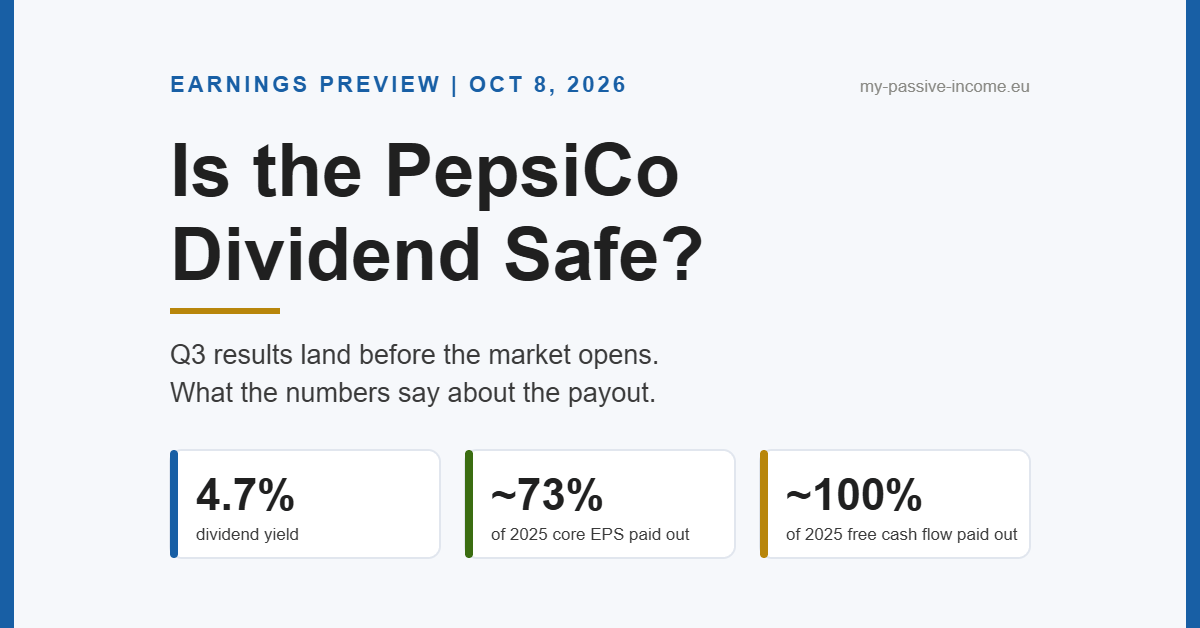
PepsiCo (PEP) reports third-quarter results on Thursday, October 8, 2026, before the market opens. For dividend investors this is one of the more interesting earnings reports of the season: the stock is trading around its 52-week low, the yield has climbed to about 4.7%, two major banks have cut their rating in the past week, and the company is coming off its 54th consecutive annual dividend increase (announced in February). The question is not whether PepsiCo will pay its dividend next quarter — it almost certainly will — but how much room the business has to keep raising it.
The key numbers before the report
- Release: October 8, 2026, with the press release and Form 10-Q posted at 6:00 a.m. ET and the analyst Q&A at 8:15 a.m. ET (quarter ended September 5, 2026).
- Consensus estimates: earnings per share of about $2.30 (roughly +0.4% year over year) on revenue of about $25.0 billion (roughly +4.3%), according to TipRanks and MarketBeat. Estimates vary slightly between data providers.
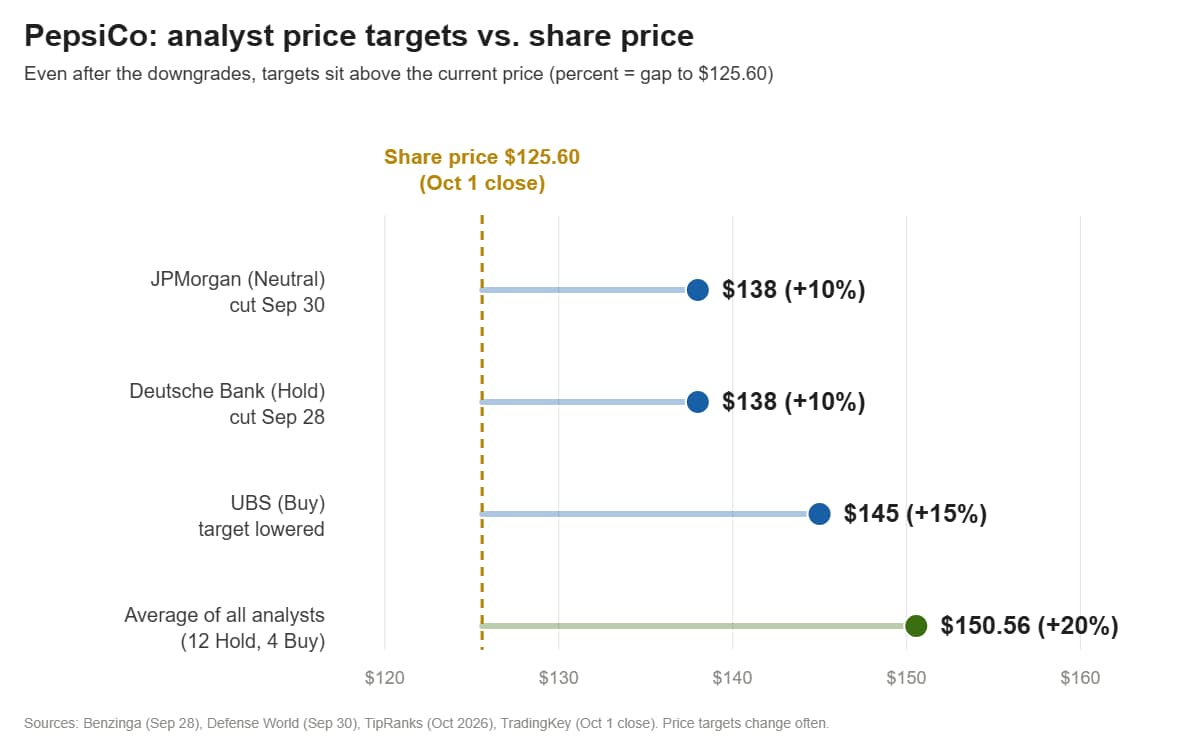
- Share price: about $125.60 at the October 1 close, roughly 10% lower since the start of the year, at about 16.6 times earnings.
- Options market: traders are pricing in a move of about 3.75% in either direction after the report.
- Analyst view: a consensus “Hold” (12 Hold, 4 Buy), with an average price target around $150–152.
Why the stock has been under pressure
The problem is North America. In the second quarter (reported July 9), PepsiCo’s core EPS was $2.20, up 4% (up 1% excluding currency), and organic revenue grew 2.4%. But the convenient foods business in North America (Frito-Lay and Quaker) saw organic revenue fall 2%, and management said North America was “softer than we anticipated” and that it now expects a “more gradual improvement” for the rest of the year. The CEO pointed to tighter consumer budgets in the U.S.
The company has been trying to win back volume by cutting prices by up to 15% on brands such as Lay’s, Tostitos, Doritos and Cheetos since February, and has since announced it will raise prices on some food and beverage items again. Activist investor Elliott Management has been pushing for more affordable pack sizes. Full-year guidance was left unchanged: organic revenue growth of 2–4% and core constant-currency EPS growth of 4–6%.
Last week the analysts turned more cautious. Deutsche Bank cut PepsiCo from Buy to Hold on September 28 (price target to $138 from $155), and JPMorgan moved from Overweight to Neutral on September 30 (price target to $138 from $170). Press coverage cites a stalled North American turnaround and weakness at Frito-Lay. UBS kept its Buy rating but lowered its target to $145, saying the near-term path looks tough but much of the downside is already priced in.
The dividend: how safe is it?
- Current dividend: $1.48 per quarter, about $5.93 a year — a raise of roughly 4% from $5.69, the company’s 54th consecutive annual increase, with dividends paid since 1965.
- Yield: about 4.7% at a share price near $126. That is high for PepsiCo historically, but it is high partly because the share price has fallen.
- Payout on earnings: about 73% of 2025 core EPS ($5.92 divided by $8.14). Some articles quote a 90% payout ratio; that figure does not match this calculation, so check which earnings measure (core or GAAP) any payout ratio is based on.
- Payout on free cash flow: this is the tighter measure. For full-year 2025, dividends paid of about $7.64 billion were roughly equal to free cash flow of about $7.67 billion, a payout of about 100% (figures as reported by 24/7 Wall St, not checked against the 10-K). In the first half of 2026, PepsiCo reported free cash flow of $1.1 billion (operating cash flow $2.4 billion minus $1.3 billion of capital spending) against $4.4 billion of dividends and $479 million of buybacks. First-half cash flow is seasonally weak for PepsiCo, but the gap is wide.
- Full-year cash plans: management guides to about $8.9 billion of total shareholder returns in 2026 (dividends plus buybacks) and free cash flow conversion of at least 80%.
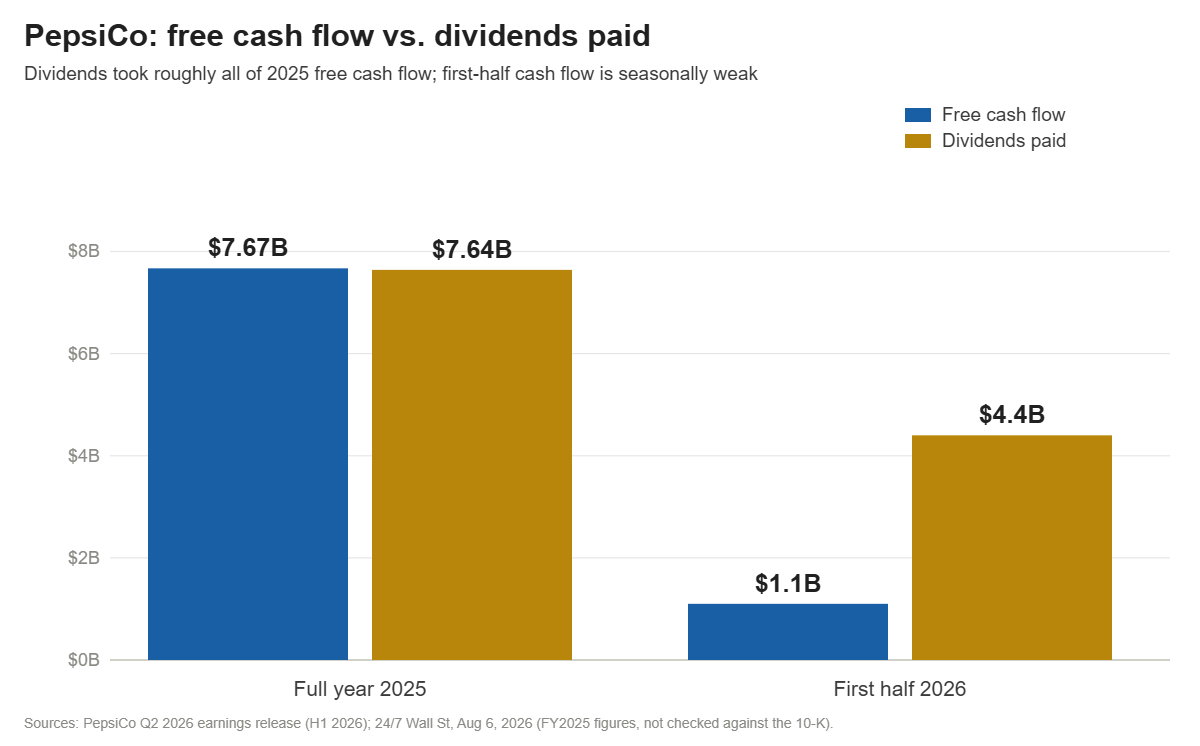
Put simply: the dividend is covered by earnings with a normal cushion, but it is covered by free cash flow with very little to spare. That is manageable for a company with PepsiCo’s scale and history, as long as earnings do not slip further. It becomes a question if North America keeps weakening and the company has to choose between investment, buybacks and dividend growth.
What to watch on October 8
- North America volumes and pricing. Are the price cuts bringing volume back, and what happens to margins when prices go up again?
- Full-year guidance. Consensus numbers suggest the 4–6% core EPS growth guidance may be under pressure. A cut would likely hit the shares even if the quarter itself is fine.
- Free cash flow. Any update on cash conversion and on the 2026 shareholder-return plan; buybacks are usually the first lever to be reduced.
- International growth. International segments posted 6–9% organic revenue growth earlier in the year; the question is whether that can keep offsetting North America.
- Management tone on the dividend. The next increase is normally announced in early February, so comments this week and in the February announcement are the real test of the streak.
What this means for a dividend-income investor
PepsiCo is the kind of stock people buy for stable, growing income, and that story is not broken: the dividend is paid, the streak is intact and the earnings payout is reasonable. What has changed is the margin for error. A 4.7% yield sounds attractive, but a high yield after a share-price decline is a signal that the market doubts growth, not a gift.
A few practical points rather than a recommendation: the options market expects a move of around 3.75%, so a single report can easily move the price by more than a quarter’s dividend (about 1.2% of the share price); a position bought for income should be judged on cash flow and dividend growth over years, not on one day’s reaction; and it is worth checking how much of your portfolio already depends on one consumer-staples name.
Notes for European investors
- U.S. dividends are subject to a 30% withholding tax by default, typically reduced to 15% (or the rate in your country’s tax treaty) once your broker has a W-8BEN form on file. Most European brokers handle this when you open the account.
- PepsiCo is listed on Nasdaq and trades in U.S. dollars, so your return also depends on the euro–dollar exchange rate.
Disclaimer: This article was written before PepsiCo’s third-quarter results and is for informational purposes only; it does not constitute investment advice. Estimates, ratings, price targets and share prices are taken from the sources cited and change frequently — confirm current figures with your broker or PepsiCo’s investor relations page. Investing involves risk, including the possible loss of capital, and a dividend is never guaranteed.