
Checked on October 29, 2026 against ESMA’s latest market report, the official text of Regulation (EU) 2020/1503 and the ECB. This article contains no referral links or bonus offers.
“Regulated” is one of the most reassuring words in investing, and one of the most misunderstood. When a crowdfunding or crowdlending platform says it is authorised under EU rules, that tells you how it must behave. It does not tell you that you will get your money back. This guide explains what the European crowdfunding regulation (ECSPR) actually requires, what it gives you as an investor, and where its protection stops.
The market in numbers: what ESMA reported for 2024
ESMA, the EU securities regulator, published its second annual market report on crowdfunding on December 22, 2025 and presented it in a webinar on January 14, 2026. The reference year is 2024.
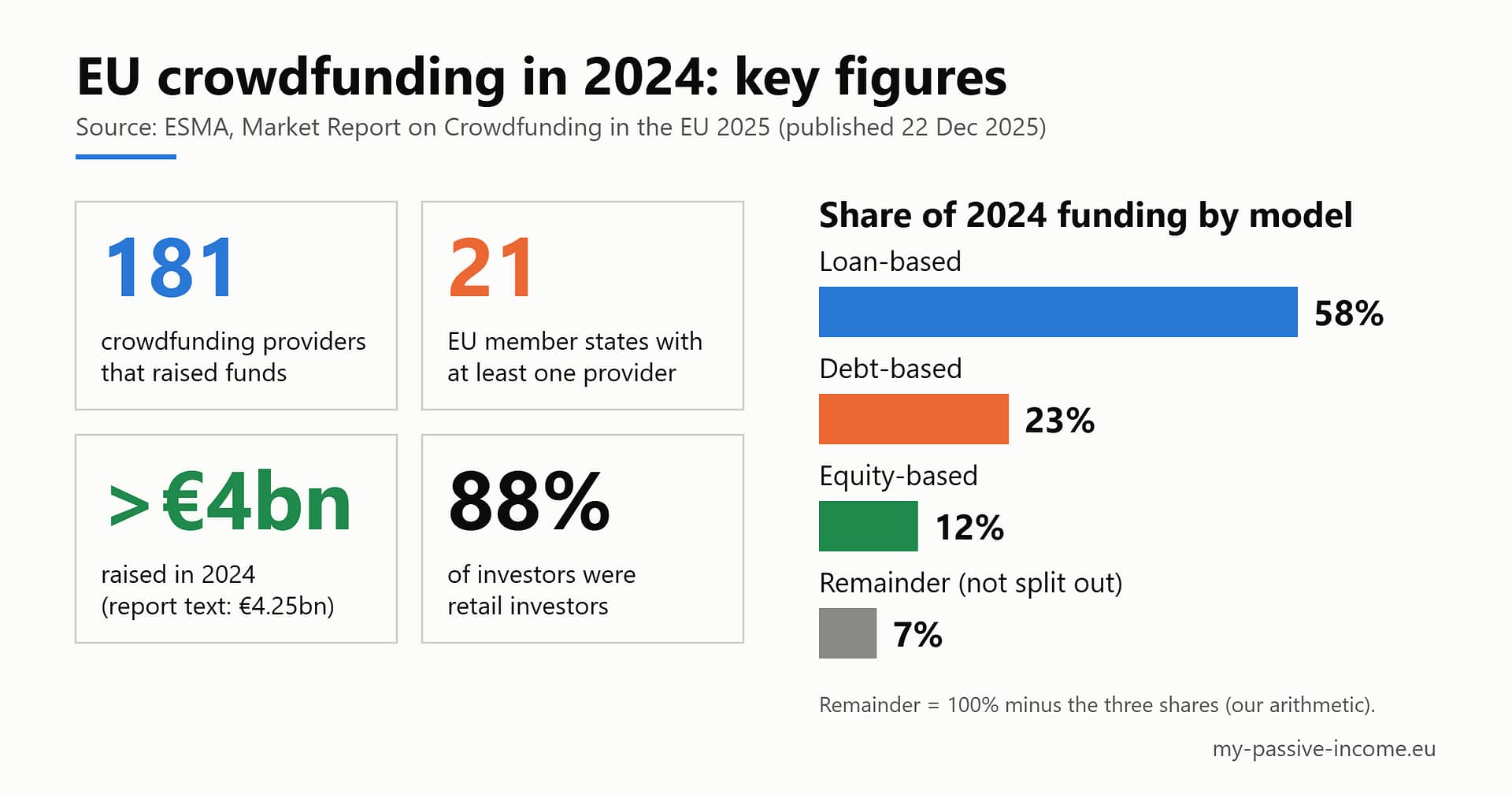
| Metric (2024) | Figure reported by ESMA |
|---|---|
| Providers that raised funds | 181, across 21 EU member states |
| Total raised | More than EUR 4bn (the report text gives EUR 4.25bn) |
| Funding by model | Loan-based about 58%, debt-based about 23%, equity-based about 12% |
| Investor base | About 88% retail, 11% sophisticated, 1% professional |
| Average amount per investor | Retail about EUR 660; sophisticated about EUR 2,660; professional about EUR 1,510 |
| Average loan-based project | About EUR 240,000 |
| Cross-border funding | About 8% of funding on average |
| Providers with “authorised” status at end-2024 | 229 in the register, including some that had not yet raised funds |
Two details are worth noting. First, the average retail investor put in roughly EUR 660, so this is largely a market of small tickets. Second, the report contains no default-rate figures for loan-based crowdfunding, and it states that it “does not provide forecasts or investment advice”. Performance data has to come from the platform itself, which is why the disclosure rules below matter.
What the regulation covers
Regulation (EU) 2020/1503, known as ECSPR, was adopted on October 20, 2020 and has applied across the EU since November 10, 2021. Platforms that already operated under national rules originally had until November 10, 2022 to get authorised; a Commission delegated act extended that to November 10, 2023, according to the European Commission.
The regulation covers business funding: platforms that facilitate loans to project owners or place transferable securities. Two limits are important. Offers above EUR 5 million over 12 months fall outside the regulation (Article 1(2)(c)), and so do services to borrowers who are consumers (Article 1(2)(a)). Platforms that mainly distribute consumer loans bought from lenders in other countries are therefore not the main target of this law; they can fall under different rules, so check which licence a given platform actually holds.
The protections investors actually get
| Rule | Article | What it means for you |
|---|---|---|
| Clear, fair information | Art. 19 | Platform information and marketing must be fair, clear and not misleading, and clients must be told that the services are not covered by deposit guarantee or investor compensation schemes. |
| Default-rate disclosure | Art. 20 | Platforms facilitating loans must publish project default rates annually, covering at least the preceding 36 months, plus an outcome statement within four months of each financial year-end. |
| Knowledge test and loss simulation | Art. 21 | Non-sophisticated investors are assessed before getting full access (reviewed every two years) and must simulate their ability to bear loss, set at 10% of net worth. |
| Warning for larger amounts | Art. 21 | Before an individual offer above the higher of EUR 1,000 or 5% of your net worth, you get a risk warning and must give explicit consent. |
| Reflection period | Art. 22 | Non-sophisticated investors have four calendar days to cancel an offer without giving a reason or paying a penalty. |
| Key investment information sheet | Art. 23 | A standalone document of no more than six A4 sides with a prescribed risk warning covering possible partial or total loss, no deposit or investor-compensation cover, and limited liquidity. The project owner is liable for misleading information; an uncorrected material error means suspension of up to 30 days and then cancellation. |
Article references come from the official text on EUR-Lex; the 10% and the EUR 1,000 / 5% thresholds were also cross-checked against a second copy of the original text.
What the rules do not do
The regulation is a disclosure-and-conduct framework. It is not a guarantee, and the law itself says so in several places.
- No deposit or compensation cover. Platforms must warn you that crowdfunding is not covered by deposit guarantee or investor compensation schemes, and the key information sheet must repeat it.
- No promise of repayment. The mandatory risk warning explicitly mentions possible partial or total loss. Authorisation of the platform is not an assessment of any single loan.
- Disclosure, not quality control. Article 20 requires platforms to publish default rates. It does not say what rate is acceptable; that judgement is yours.
- Limited liquidity. The warning on the information sheet covers it. Exit options depend on the platform and on other investors.
- Gaps in scope. Offers above EUR 5 million, consumer-loan services and platforms that are not authorised under ECSPR sit outside these protections.
A six-step checklist before you invest
- Confirm the authorisation. Look for the platform’s authorisation with its national authority or in ESMA’s register, and make sure the legal entity matches the one you contract with.
- Read the default-rate page. Look for the 36-month history and the latest outcome statement, and note the date. One good year says little.
- Read the key information sheet in full. It is short by design. Pay attention to the risk warning, the project owner and what the funds are used for.
- Treat the loss simulation as a floor for caution. The 10% figure is a rule set by the law, not personalised advice about your situation.
- Use the four-day reflection period if something seems unclear after you have committed.
- Keep ticket sizes in proportion. ESMA’s average retail investment of about EUR 660 shows how most people approach this market: small amounts spread over several projects.
Why the yield comparison matters now
The ECB’s deposit facility rate stands at 2.50% (effective September 16, 2026, per the ECB’s key-rates page, accessed October 29, 2026). Higher advertised platform yields exist because lenders accept credit, liquidity and platform risk, none of which the regulation removes. For the bank-side comparison see our guide to EUR savings accounts and our note on the ECB rate move. For the other side of the risk, read platforms that collapsed or are in trouble and REITs vs real estate crowdfunding.
Sources
- ESMA, Market Report: Crowdfunding in the EU 2025 (published December 22, 2025; reference year 2024)
- ESMA webinar page, 2025 market report on crowdfunding (January 14, 2026)
- Regulation (EU) 2020/1503, official text on EUR-Lex (accessed October 29, 2026)
- Article 21 of the original text, copy on legislation.gov.uk (cross-check; accessed October 29, 2026)
- European Commission, EU crowdfunding rules (accessed October 29, 2026)
- ECB, key interest rates (accessed October 29, 2026)
Get new articles by email
Ex-dividend dates, earnings previews and P2P platform changes, straight to your inbox. Unsubscribe anytime.
Disclaimer: This article is for informational purposes only and does not constitute investment advice. Figures come from the sources listed, as of the times stated, and may be revised. Confirm current terms directly with the platform and the competent authority before investing. Investing involves risk, including the possible loss of capital.