A company announces a dividend, but you only receive it if you own the shares on the right day. That day is set by the ex-dividend date, and it is the date most investors mix up with the record date and the payment date. This guide explains the four dates in plain English, shows how they line up in a real 2026 example (Microsoft’s $0.98 quarterly dividend), covers what happens to open orders on the ex-dividend date, and lists what this guide does not cover yet.
Official pages were read on 17 November 2026. Rules and market conventions change, so confirm the dates with your broker or the company before you act.
Key takeaways:
- To receive the next dividend you must buy the shares before the ex-dividend date. Buying on the ex-dividend date or later means you miss that payment.
- For U.S. stocks the ex-dividend date is usually the same day as the record date, according to the SEC’s investor education site.
- The ex-dividend date is not a payment date: the money usually arrives weeks later, on the payable date.
- The dividend is not free money: on the ex-dividend date, U.S. brokers must reduce open orders by the dividend amount (FINRA Rule 5330).
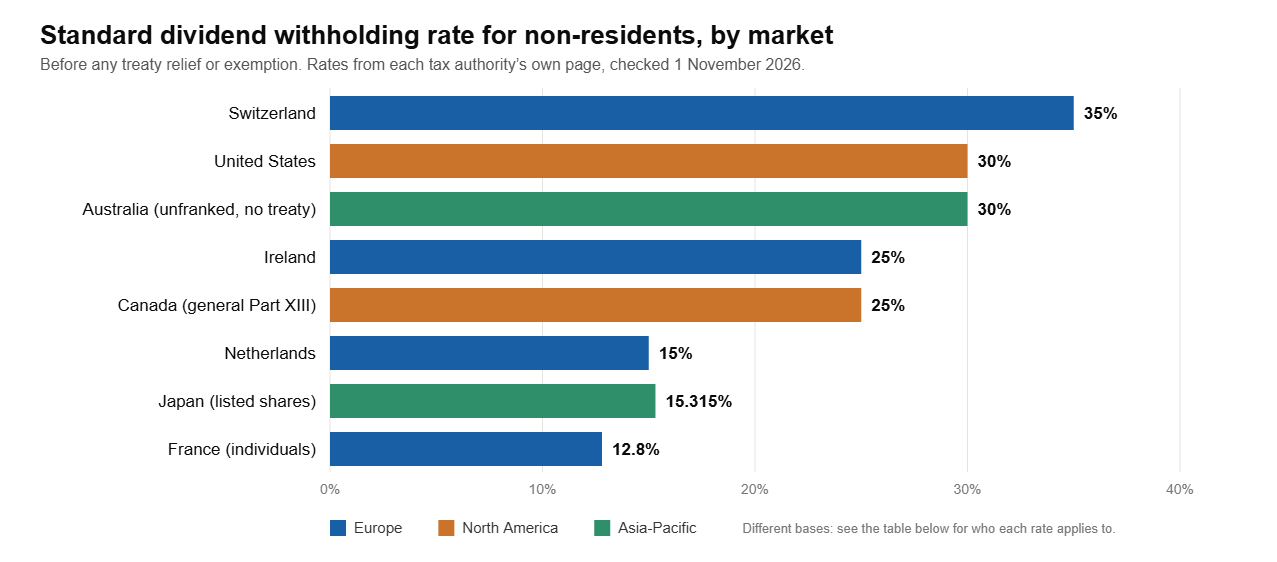
- Tax is a separate step: foreign dividends can be taxed at source, which our withholding guide covers.
Watch the video summary
A 70-second video summary of this guide: the four dates, a real Microsoft example and why the dividend is not free money.
The four dates of a dividend
| Date | What it means | What it means for you |
|---|---|---|
| Declaration date | The company announces the dividend and its amount. | Nothing to do yet; this is when you can find the other dates. |
| Ex-dividend date | The first day the shares trade without the right to the next dividend. It is set under stock exchange rules. | Buy before this day to receive the dividend. Buy on or after it and you do not. |
| Record date | The day you must be on the company’s books as a shareholder. | For U.S. stocks it is usually the same day as the ex-dividend date. |
| Payable (payment) date | The day the dividend is paid. | The cash arrives in your account on or after this day, through your broker. |
The SEC’s investor education site (Investor.gov) puts the key rule in one sentence: buy on or after the ex-dividend date and you will not receive the next dividend. It also notes that selling before the ex-dividend date means you give up the dividend too.
A real example: Microsoft, November 2026
Microsoft announced on 15 September 2026 a quarterly dividend of $0.98 per share. Its press release gives 19 November 2026 as both the record date and the ex-dividend date, and 10 December 2026 as the payable date. A Thursday ex-dividend date means the last day to buy and still receive the dividend is the day before: Wednesday 18 November.
| If you buy Microsoft shares on… | Do you get the $0.98? |
|---|---|
| Wednesday 18 November 2026 | Yes (you bought before the ex-dividend date) |
| Thursday 19 November 2026 (ex-dividend date) | No |
For 100 shares the gross payment would be $98 (our arithmetic: 100 x $0.98), paid on 10 December 2026, before any tax withheld at source and before your own country’s tax. The same rule applies to any company; only the cut-off day changes.
What happens to the share price on the ex-dividend date
The dividend leaves the company’s cash on the payable date, and the market treats the shares as worth less from the ex-dividend date onward. One official sign of this is FINRA Rule 5330: on the ex-dividend date, a U.S. broker holding an open order for a customer must reduce it by the amount of the cash dividend before execution (unless the dividend is under one cent or the order is marked “Do Not Reduce”). So a limit order to buy at $100 becomes $99.02 for a $0.98 dividend, in principle, before rounding to the price increment. This is why buying just before the ex-dividend date to “collect” a dividend is not a free gain: you receive the dividend, but the shares are expected to be worth about that much less afterwards. What the price actually does on the day is not fixed by any rule.
Edge cases the SEC page mentions
- Weekend record date: if the record date is not a business day, the ex-dividend date moves to the prior business day.
- Special dividends of 25% or more of the stock’s value: the ex-dividend date is deferred until one business day after the dividend is paid.
- Stock dividends: the ex-dividend date is set the first business day after the stock dividend is paid.
How to use this in practice
- Find the company’s announcement (investor relations page or stock exchange notice) and note the ex-dividend date and the payable date.
- Check your broker’s cut-off: your order must be placed and filled before the ex-dividend date, in the exchange’s time zone.
- Look at the tax before you chase the payout. Foreign dividends can be taxed at source; see dividend withholding tax by country and, for U.S. shares, Form W-8BEN explained.
- Ask whether the dividend is worth holding for, not only collecting: a company’s dividend history matters more than one payment. Our weekly ex-dividend list shows the dates and amounts for a given week.
What is not covered yet
- Ex-dividend rules outside the United States. In other markets the ex-dividend date may fall before the record date, and the gap depends on each market’s settlement cycle. We could not read an official exchange page on this in the latest check, so we do not state a rule for the UK or the euro area here. Always use the date in the company’s own announcement.
- The EU move to a one-day settlement cycle (T+1). ESMA, in a page dated 18 November 2024, recommended 11 October 2027 as the date for the EU to move to T+1 and said that legislative changes were still needed. We have not confirmed the current legal status, so we leave out what it would change for EU ex-dividend dates.
- Scrip dividends, dividend reinvestment plans, ADRs, ETF distributions and the tax treatment of a dividend in your home country.
Sources
All pages were read on 17 November 2026 unless stated.
- U.S. Securities and Exchange Commission, Investor.gov glossary, “Ex-Dividend Dates: When Are You Entitled to Stock and Cash Dividends” (no page date shown): investor.gov
- FINRA, Rule 5330 “Adjustment of Orders” (version effective 19 April 2010): finra.org
- Microsoft, press release “Microsoft announces quarterly dividend increase”, 15 September 2026 (read as the PR Newswire copy on placera.se): press release; Microsoft investor relations, dividends page (shows the latest declared dividend of $0.98 per share, no dates): microsoft.com
- ESMA, “ESMA proposes to move to T+1 by October 2027”, page dated 18 November 2024: esma.europa.eu
Get new articles by email
Ex-dividend dates, earnings previews and P2P platform changes, straight to your inbox. Unsubscribe anytime.
Disclaimer: This article is for informational purposes only and does not constitute investment, tax or legal advice. Dividend dates and amounts are taken from the company release and the official pages listed, as read on the date stated; the examples and calculations are our own arithmetic. Market rules differ by country and change over time. Investing involves risk, including the possible loss of capital, and a dividend payment is never guaranteed.